This is our final film, we have made alot of alterations and are finally happy with our final outcome.
Showing posts with label Laura Wolvers. Show all posts
Showing posts with label Laura Wolvers. Show all posts
Wednesday, 10 April 2013
Final Film
This is our final film, we have made alot of alterations and are finally happy with our final outcome.

Tuesday, 9 April 2013
Final Poster

After receiving audience feedback for our film posters, we decided that this would be our final poster. We felt that it had more relevance to the narrative of the film because the phone is one of the main reasons which causes the main character to judge Sam's character. We also felt that of the other posters we created, this one looked the most professional because of the effects which were used in its production.
Monday, 8 April 2013
Teaser Trailer 2
This is another teaser trailer that I made since we collected all our footage and began editing.
Alternatively, please follow this link to watch it on YouTube:
http://www.youtube.com/watch?v=ray9GQ4wr9M
Teaser Trailer and Radio Advert
This is the trailer i made for our film, we found it was best to do individual ones as we both could come up with different idea's on what we want to present our trailer as. I wanted my trailer to be in black and white as this edit is in our actual film. Also due to the sections of our film, it allows more mysteriousness to what our film is about, this also sets up the girl in the hoody to be portayed as a "trouble maker" which is what we would want our audience to think to allow the ending to be a suprise.
This is the Radio Advert i made, i didn't want to give much of the story away and so the advert it short. I played our non-diagetic music as a background track in this as it gives a more upbeat sound than our mysterious trailer as that has no soundtrack to it. This sound gives our audience the impression that although our film is mysterious, it is not a dark film and emphasises the "drama" genre apose to a crime/thriller genre. Also the music is played in the actual project so the audience would recognise this sound, conventional to a radio advert, also included character lines from the film which was limitted as we didn't have many lines for our characters.
Wednesday, 3 April 2013
Evaluation
1) In what way does the media product use, develop or challenge forms and conventions of real media products?
During the production of
our film, we were very aware of maintaining continuity throughout. We used the
180 degree rule to make sure that the audience would not become confused if the
characters suddenly changed positions, and we also edited using match on action
to make the end product appear smooth and natural. The shot/reverse shot
technique is also something we used when shooting our film, because this is an
efficient way of shooting conversations between characters.
Here are the different variety of shots that we used during filming. We wanted to follow the conventions of a drama film by using both cinematography and editing to make our film visually interesting to watch. Because if every shot was long and continuous, the film would be boring. By switching and changing the shots we used, the film had more of an appeal.

Below is a finished video we compiled after having practised some of our more difficult shots. We decided it would be beneficial to do this so that we would have some experience of how to frame and shoot these shots when it came to the day of production. I personally found this very helpful because it made me feel more confident about using difficult shots and executing them.
However, we
challenged the convention of retaining continuity toward the end of our film
when the truth behind the narrative is revealed. In order to convey to the
audience that there is always more than one way of looking at a situation, we
decided to repeat the sequence of film again, but use different angles to shoot
it from. This meant crossing the 180 degree line, but because the idea behind
the sequence was to look at the situation from a different perspective, we
wanted to reflect this visually as well as morally. This inspiration derived from the Guardian advert that we found during the research stage of our project. During the editing process,
we found that this looked very effective, and even decided to take it a little
further by applying a ‘black and white’ filter to show that this is a replay of
events which have already occurred (again, similar to the Guardian advert). |
| The 180 degree rule |
 |
| Eye-line match/pull focus shot/match on action |
Below is a finished video we compiled after having practised some of our more difficult shots. We decided it would be beneficial to do this so that we would have some experience of how to frame and shoot these shots when it came to the day of production. I personally found this very helpful because it made me feel more confident about using difficult shots and executing them.


Our film subverts expectations of the genre we have chosen due to its morally driven narrative. We maintained all the standard iconography of the drama genre, including realistic settings (e.g. a house, a park, a street…), realistic characters, and every day objects for props (e.g. a pen, a notepad, folders, a phone…) to make it clear for the audience what kind of genre our film would be. Normally, a film in the drama genre will focus on the situation a character finds themselves in, and as a result may subconsciously make the audience reflect on their own principles or behaviour. In contrast, we wanted to deliberately subvert the conventions of the genre by making the audience question themselves directly. The plot is set up so that the audience judges the suspicious character on instinct, and by showing the other side of the situation, and then asking the direct question ‘did you jump to conclusions?’
we achieve this.
 |
| Question title at the end of our film to engage audience |
 |
| Real locations and every day objects for props |
 |
| Knight and Day |
Guardian advert
The chief purpose of our film is to target the audience
by using stereotypical characters and appearances to bring out their natural
reactions. In doing this we can highlight just how easily people can be
prejudiced against someone or a situation. Even though our film does not
contain a lot of action or excitement, we wanted to aim for a clever narrative
that had a twist and surprised people. I believe that we have achieved this
successfully.
In relation to the Uses and Gratification Theory, we aimed to give the audience pleasure through both entertainment and providing them with a model situation of someone learning their lesson after acting prejudiced toward someone. In addition, if the audience goes away feeling as if they have learned something from our underlying moral message, then that is a bonus. Overall, I believe that we have achieved this.Our film also follows 'Todorov's Theory of Narrative'. Todorov believed that most narratives have 5 stages to them which makes for an interesting piece of film. This is how our narrative is structured, as shown below. Syd Field's theory is also shown below, similar to Todorov's idea that every narrative has a similar structure. The only difference is that he believed every film has 3 main plot points.


As in most films, our narrative rises to a climax and then dips again to reach a new equilibrium. The 'equilibrium' at the start is that Millie and her mother's relationship is fine. They are out walking and there is nothing out of place. Then the climax arises when Sam steals Millie's phone, and the event is when Millie realises something is wrong and that there is a disruption in the park between Jodie and Sam. Her attempt to solve the problem at the end of the film is both the moment she thanks Sam for taking her phone back and again when she apologises to her mum. In some cases films finish with a return to the original equilibrium because everything goes back to the way it was before. However, our film ends with a new equilibrium because Millie admits her mistake, and there is an unspoken implication that she will not jump to conclusions again.

Similarly to Todorov's Theory, our film has a 3 act plot structure like Syd Fields suggested. The beginning (the setup) is when Millie and her mum are coming back from a walk and Millie judges a stranger and comes to a disagreement over it with her mother. The middle (the confrontation) is when Sam 'steals' the phone from Jodie in the park, because this sets up the climactic point of the film. Finally, the end (the resolution) is when Millie thanks Sam for taking her phone back, and when she apologises to her mum over text at the very end of the film.
2) How effective is the combination of your main product and the ancillary texts?
Evaluation (2) from LauraWol
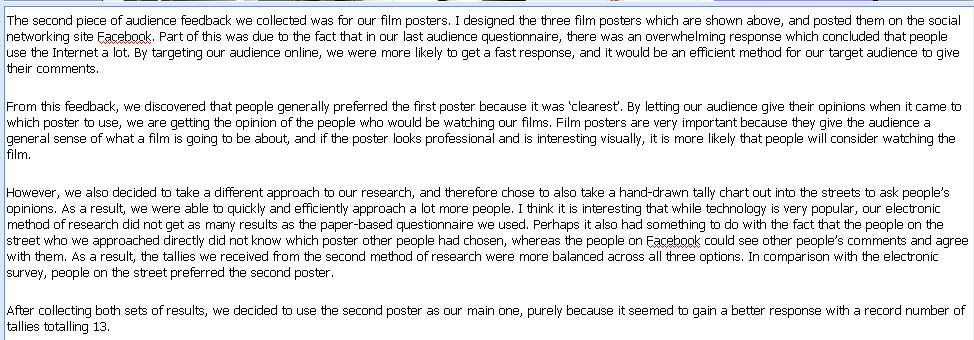
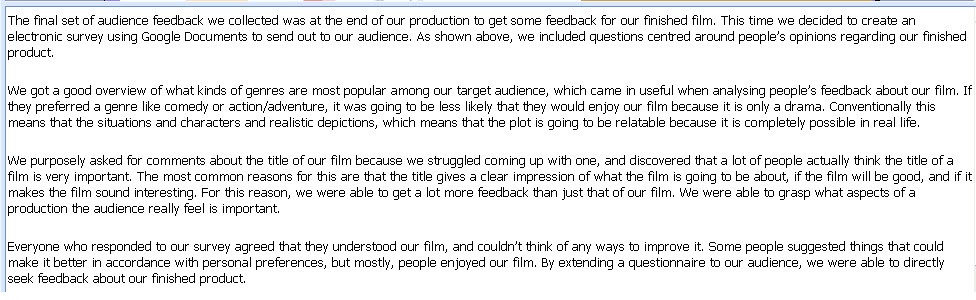
3) What have you learned from your audience feedback?





4) How did you use new media technologies in the construction and research, planning and evaluation stages?


OTHER

I used iMovie to create a small teaser trailer for our film because I wanted to experiment with a different program as opposed to using FinalCut again. I found this program easy to use, and this is one of the reasons I prefer FinalCut because it allows you to do more with your footage.

I used paint quite a lot to edit my images quickly. I have a lot of experience using this program, so I found it easier and much faster to crop, resize and merge photos on this program. As opposed to Photoshop, this program does not require a lot of experience to be able to use it well.

I used MovieMaker to create another teaser trailer, but found this too simple to use. It did not offer me enough effects to use on our footage, so I was not happy with the end result. I was only able to use titles, credits, videos, images and sound. There were no filters.

I found Photoshop more efficient to use for creating my film posters. There were so many different effects for me to play around with, and in the end I think my finished poster looked more professional. I was able to add filters like 'black and white' and 'motion blur' to my images to give them a more authentic, detailed look. After using the program multiple times, I found that it became easier to use.

I used Powerpoint to present my theory notes in a way that made them more interesting visually to look at on the blog. I also used it to make brainstorms and mindmaps because the program allows you to use different colours and fonts to make the brainstorms more interesting.

Mostly, I used word to create shot lists, to write up the treatment for our film, and to create the analysis of my film posters.
Tuesday, 12 March 2013
Film Audience Feedback
Here is our audience questionnaire for people to fill in after watching our film. By using this, we will be able to collect enough feedback to understand how our finished product comes across to its intended audience.
Below is the feedback that we received from our audience shown as a summary.


Summary of Feedback
Overall, our audience feedback has been very helpful. It is clear from this summary of results that most of the people that watched our film were within the age groups that formed our initial target audience of adults. The responses we received came from the 16-20, 21-40 and 41-60 categories, with 2 people in the first category, 3 people in the seconds category, and 2 in the third. We wanted to aim our film at a mainstream audience because they are the most likely to understand the underlying moral message to our narrative. It is a well-known fact that most young people tend to enjoy films mostly linked with genres like action/adventure, fantasy, romance, comedy, thriller, horror, suspense, and sci-fi. Adults audiences tend to often enjoy films of similar genres, yet they are more likely to watch dramas because they are more likely to relate to situations and characters.
When asked what kind of films people usually watch, the most popular answers were 'romance' and 'comedy'. 'Action/adventure' received one vote, as did the 'other' genre because one person said they like all genres. This tells us that perhaps based on this particular questionnaire, people are less likely to watch dramas when they have the choice of indulging in other genres like romance and comedy or action/adventure.
One of our survey questions was 'do you think the title of a film is important? If so, why?' We wanted to ask this questions because we found the title of our film very difficult to come up with. Of all the responses we received, every person agreed that the title of a film is very important. Below is a bullet point summary of their reasons:
- If the film has a good title you are more likely to want to read what it is about
- Some people think the title reflects how good the film is going to be based on its title
- It's the first think you get from a film so if the title isn't interesting or appealing, people are less likely to watch it
- They usually give you an impression or an overview of what the film is about
One person agreed that the title of a film is important, but made the valid point that some good films have bad titles and vice versa, so it depends on the individual film.
Following this question, we asked people what they thought about our film title, and we received a mostly positive response. A few people thought our title was intriguing and made you want to find out what happens in the film. Another person said that it could mean several things, which is more than likely going to encourage people to want to find out what the film is like. Others liked it because it was unusual, it gave a clear overview of the moral message in the narrative, and liked that it was used relevantly throughout the film to signpost the moral message to make it clear to the audience. One person disagreed and said that it was maybe too long. This is true because a lot of people like one-word films titles that are sharp and concise, and maybe even conceal the plot which could be more intriguing for people. Perhaps this is something we could have improved on, because our title clearly reveals the plot of the film.
Of all the people who watched our film and completed the survey, all seven people understood our film. This means that our narrative turned out very clear, possibly because of the additional scene we added onto the beginning.
In terms of improving our film, one person suggested that the acting could have been better and that some scenes flowed better than others. Most people agreed that they couldn't think of any ways for the film to be improved. One person suggested that in correspondence with their personal preference of comedy films, it would have been better if there had been some comedic value to the narrative. As a result, six of the seven people replied that they enjoyed our film, meaning that only one person answered 'mostly'. Perhaps this is down to personal preference. The more specific responses as to why people enjoyed our film are listed below:
- Has a good moral message and highlights something that is still a problem in society today
- Unusual and had a good twist, didn't expect the stereotypes of the characters to be flipped at the end
- Targets the audience, whereas most films the audience is just expected to sit back and watch. Makes you question yourself for judging
- Isn't like any other film that has been made before, unique
Finally, we asked people if they would consider recommending our film to others. Of the seven people that took the survey, 4 replied that they would, and 3 said 'maybe'. Overall, this is a very good result. We feel that as long as our audience was satisfied, our film has turned out to be a success.
In conclusion, we are able to discern from our audience feedback, that people have their own personal preferences, and therefore will enjoy a film based on what they normally watch. Everyone has a genre that they really like, but generally, our film was enjoyable enough to watch because it was different and unique.
Filming photos from Production Day 4
These are the filming photos from Production day 4. This was the additional scene that we filmed out in the street, in the front garden and in the kitchen of Millie's house. Filming went really well on this day because we felt more comfortable after already having the main bulk of our film completed and having the script and storyboard done beforehand.

Monday, 11 March 2013


Thursday, 7 March 2013
Storyboard for our Additional scene
Below is the first draft of a storyboard that I created for our additional scene. This scene will go before the main bulk of our film that we have already edited.


Wednesday, 6 March 2013
Costume and Location photos for our Additional scene
Street


We wanted to use the same locations that we use later on in the film so that the style of our film is consistent. This way the film makes sense all the way through and there is no break between the additional scene and the rest of our film. The lighting was also perfect, because of the nature of the scene (judging people and being suspicious of someone) we wanted the location to look dark and not too sunny.
Millie's house and garden


Again, by using Millie's house at the beginning of the film, the additional scene seamlessly fits with the rest of the film because the location is the same.
Costumes

We decided to keep Sam's character in the same kind of outfit that we see her in the main part of the film later on. This way the audience knows straight away that this is the character that Millie questioned the day before. The dark clothing naturally makes her seem suspicious, and is the stereotypical kind of costume that is used in films for gangsters and 'bad' characters, so this will make it easier for us to challenge the conventions of the genre.

Millie's character is wearing a similar outfit to the one she wears in the main bulk of the film - a trendy outfit, yet something an average teenage girl might wear, nothing too extravagant.

Similar to Millie, her mum dressed fashionably yet comfortably. We chose a similar outfit to the one she wears in the rest of the film to keep a consistency with the character.
Subscribe to:
Posts (Atom)